

All games
Spider Solitaire
Build runs from king to ace and clear the table. Choose one, two, or four suits to find your level of challenge.
25 min · Variable
Start a solo game. You can review the controls before your first move.
Guides & strategy
Worked examples and ideas to try in your next game.
How to play
Goal
Clear the tableau (the main card layout) by completing eight suited King-to-Ace runs.
- What am I trying to do?
- Arrange cards from King down to Ace in one suit. Each complete exposed run moves to the completed tray. Clear all eight runs to win. The game uses 104 cards across ten columns, plus a stock dealt in packets of ten.
- How do I select and move cards?
- Select an exposed card, then select the destination column. A selected card moves with every card below it, so that whole tail must be a legal run. Fine-pointer devices also support dragging. Selections alone do not make a move.
- What makes a legal move?
- 7 is exactly one rank below 8. Spider accepts the landing regardless of color or suit; suit matters when moving a group or completing a run. Every card in the moving group was face-up, descended by one and shared one suit. The engine moved the whole group together. Moving the last exposed card uncovered the Queen below it. The engine turned that newly exposed card face-up automatically. Spider allows any exposed card or valid suited run into an empty column. It does not require a King.
- When can I deal another row?
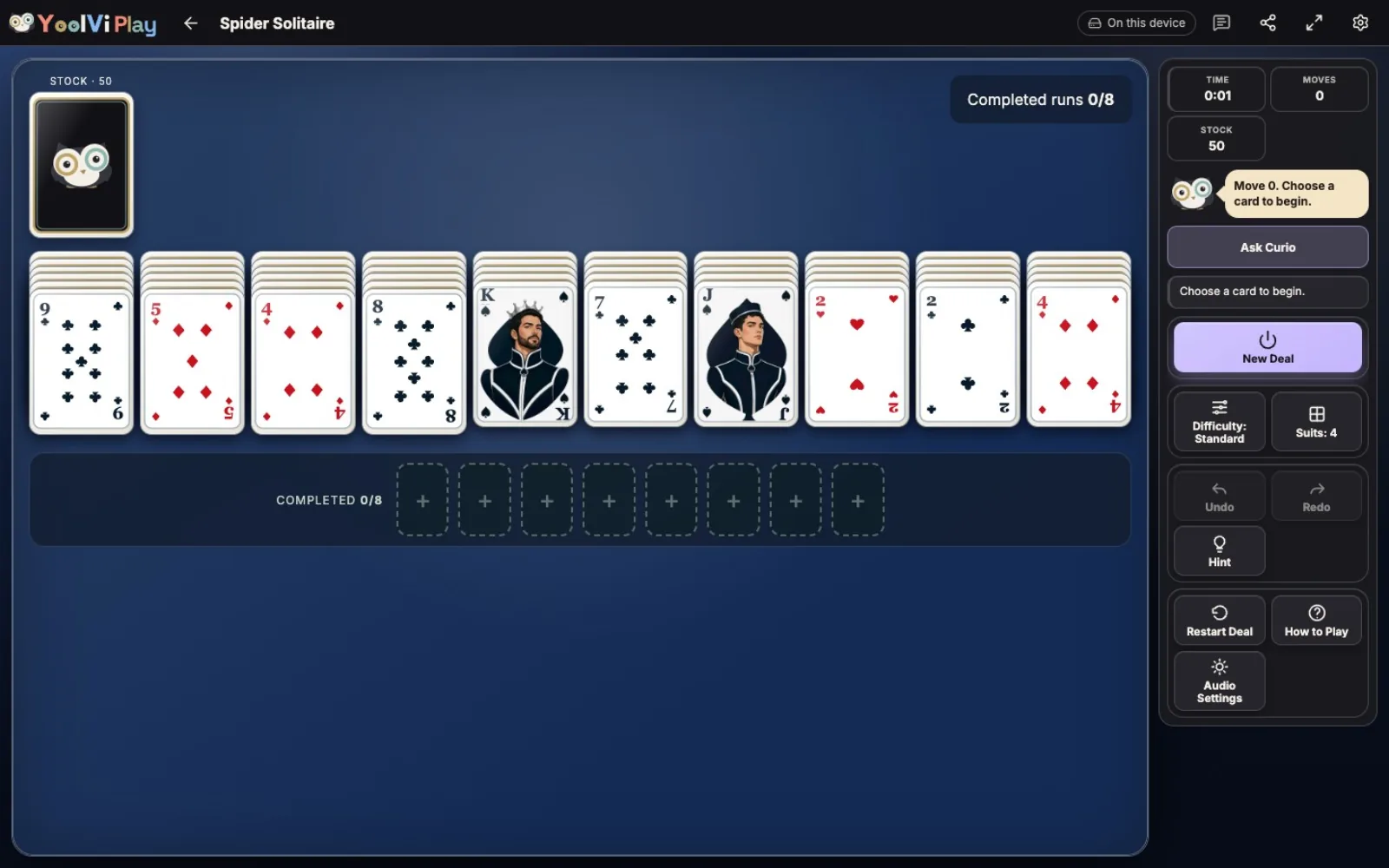
- This version starts with 54 tableau cards: six in the first four columns and five in the other six. The remaining 50 cards form five packets of ten. Fill every empty column before dealing a packet. Each packet adds one face-up card to every column and counts as one committed move. Unlike some traditional descriptions, this version has no partial final packet.
- How do completed runs work?
- The move completed an exposed King-to-Ace run of one suit. The engine removed those thirteen cards into the completed tray. The final Ace completed the eighth King-to-Ace run. All 104 cards were in the completed tray, so the real engine confirmed the win.
- What changes in One Suit?
- This walkthrough starts with One Suit: every card is a spade. Eight copies of each rank still make 104 cards. Suits change later at fixed points in the lesson.
- What changes in Two Suits?
- Two Suits uses spades and hearts. A card may land on either suit one rank higher, but a mixed-suit stack cannot move together. Move its exposed cards separately until a suited run forms. The landing was legal because the ranks differed by one. The resulting mixed-suit pair would need to be separated before moving as a group. The group shared one suit even though this deck contained two. Only the cards being moved must form a suited run.
- What changes in Four Suits?
- Four Suits uses clubs, diamonds, hearts and spades, with two copies of each card. Movement and completion rules are unchanged: mixed landings are legal, moving groups and completed runs must share one suit. The cross-suit landing was legal. Four Suits adds more sorting decisions while preserving the same descending-rank rule. Every moving card shared clubs and descended by one, so the engine accepted the whole group.
- What happens when I run out of moves?
- After the last packet, there are no redeals. The engine declares a loss when stock is empty and no legal tableau move or supported cell move remains. With cards still in stock, a blocked position is not automatically declared lost. The final ten cards used up the stock. The engine found no legal tableau or cell move and declared the board lost.
- What changes with difficulty?
- Relaxed, Standard and Challenge select separate pools of at least 100 verified solvable deals per supported suit count. Relaxed favors more straightforward routes, Standard calls for more planning, and Challenge favors more demanding choices or rearrangements. Hint, Undo and Redo remain available at every solo level. Changing difficulty starts a new rated deal; older saved deals are unrated. Exact portal challenges keep their fixed deal and assistance restrictions. Ratings are a pilot for player feedback.
- Are there points or a time limit?
- There is no point target or time limit. Normal play records elapsed time, committed moves, hints, undos and the win. Restart Deal restores the same deal; New Deal chooses another. Normal hints suggest legal progress and do not move cards for you.
Controls & accessibility
Some reading · Best on tablet, computer, TV, phone
KeyboardReady to use
MouseReady to use
TouchWhen available
ControllerGamepad ready
Fullscreen: Supported
Accessibility
Features available in this game
Screen readerNot available
High contrastAvailable
Reduced motionAvailable
CaptionsNot needed for game sounds
- Reviewed for keyboard names, larger text, contrast, motion, and non-audio instructions.
About
Account saving: Cloud unavailable.
- Version
- 0.1.89
- Developer
- YoolVi Play
- Content rating
- Everyone